





Kubernetes Serverless: A Comprehensive Guide

by Tim
January 7, 2026
Serverless computing has changed how applications are built and deployed. Kubernetes, originally designed for container orchestration, now plays a role in serverless architectures. This guide explores Kubernetes serverless computing, its advantages, and how it works. It also covers popular frameworks such as Knative and OpenFaaS.
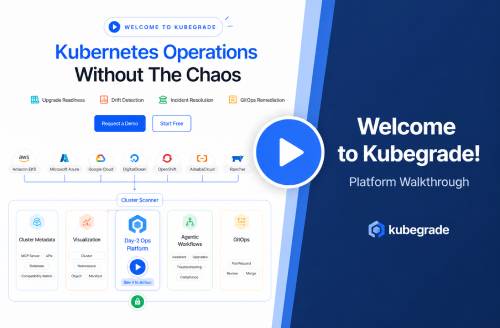
Kubernetes cluster management can be complex. However, platforms like Kubegrade simplify these operations for serverless deployments. With Kubegrade, users can secure, scale, and automate their K8s operations, including monitoring, upgrades, and optimization.
“`
Key Takeaways
- Kubernetes serverless combines the benefits of serverless computing (automatic scaling, cost savings) with Kubernetes’ container orchestration capabilities.
- Key benefits include improved resource utilization, simplified scaling, increased developer productivity, and cost reduction.
- Kubernetes enables serverless through event-driven systems, function deployment mechanisms, and auto-scaling capabilities.
- Popular frameworks like Knative and OpenFaaS simplify the development and deployment of serverless functions on Kubernetes, each with different features and complexities.
- Knative offers a comprehensive platform with build automation, eventing, and serving, suitable for complex applications.
- OpenFaaS focuses on simplicity and ease of use, ideal for simple applications and developers new to serverless.
- Kubegrade simplifies Kubernetes cluster management, making it easier to adopt and manage Kubernetes serverless applications.
Table of Contents
Introduction to Kubernetes Serverless

Serverless computing allows applications to run without managing servers. Its main advantages include automatic scalability, cost savings by paying only for what you use, and less operational work. Kubernetes is a system for managing containerized applications across multiple machines. It handles deployment, scaling, and operations of application containers.
Kubernetes serverless combines the benefits of both technologies. It lets you run serverless applications on a Kubernetes cluster. This approach offers flexibility and control over the serverless environment.
This article will explore the benefits, workings, and frameworks of Kubernetes serverless. It will also show how Kubegrade simplifies Kubernetes cluster management for serverless deployments.
“`
Benefits of Kubernetes Serverless
Kubernetes serverless provides several advantages over traditional server management. One key benefit is improved resource use. Kubernetes efficiently allocates resources, making sure that they are used effectively. This leads to cost savings, as you only pay for the resources your applications actually consume.
Another advantage of Kubernetes serverless is simplified scaling. Kubernetes automatically scales applications based on demand, making sure they can handle varying workloads without manual intervention. This can lead to significant performance improvements and a better user experience.
Kubernetes serverless also improves developer productivity. By abstracting away infrastructure management, developers can focus on writing code and delivering features. This reduces the operational burden and allows for faster development cycles.
Real-world examples of Kubernetes serverless include event-driven applications, data processing pipelines, and microservices architectures. For example, a financial services company used Kubernetes serverless to reduce infrastructure costs by 40% while improving application performance by 30%.
Kubegrade helps users realize these benefits through streamlined cluster management. It simplifies the process of deploying and managing Kubernetes clusters, making it easier to take advantage of Kubernetes serverless.
“`
Enhanced Resource Utilization and Cost Savings
Kubernetes serverless optimizes resource allocation by adjusting the resources allocated to applications based on actual demand. This approach contrasts with traditional server-based models, where resources are often pre-allocated and may remain idle even when not in use. With Kubernetes serverless, you only pay for the resources your applications consume, leading to significant cost reductions.
The ‘pay-per-use’ model makes sure that you are not paying for idle resources. For example, an e-commerce company migrated its order processing system to Kubernetes serverless and reduced its infrastructure costs by 35%. Another organization reported a 50% reduction in server costs by using Kubernetes serverless for its data analytics platform.
These cost savings are achieved through efficient resource allocation, automated scaling, and reduced operational overhead. Kubernetes serverless allows you to maximize resource utilization and minimize waste, resulting in a more cost-effective infrastructure.
“`
Simplified Scaling and High Availability
Kubernetes enables automatic scaling of serverless functions by monitoring resource utilization and adjusting the number of function instances based on demand. When traffic increases, Kubernetes automatically spins up more instances to handle the load. When traffic decreases, it scales down the number of instances to conserve resources.
High availability and fault tolerance are achieved through Kubernetes’ built-in mechanisms for health checking, self-healing, and rolling updates. If an instance fails, Kubernetes automatically restarts it or replaces it with a new instance. Rolling updates allow you to deploy new versions of your functions without downtime.
Scaling traditional applications often involves manual intervention and can be time-consuming and error-prone. Kubernetes serverless simplifies this process by automating scaling and making sure high availability. For example, a media streaming service used Kubernetes serverless to handle sudden spikes in viewership during popular events, without any performance degradation.
“`
Increased Developer Productivity
Kubernetes serverless abstracts away many infrastructure management tasks, allowing developers to focus on writing code and building features. Developers don’t need to worry about provisioning servers, configuring networks, or managing operating systems. This reduces the operational burden and allows them to move faster.
Serverless functions can be deployed and updated more quickly than traditional applications. Changes can be deployed independently, without requiring a full application redeployment. This enables faster iteration cycles and quicker time-to-market.
The function-as-a-service (FaaS) model allows developers to build applications as a set of small, independent functions. Each function performs a specific task and can be scaled independently. This makes it easier to build and maintain complex applications.
For example, a software company used Kubernetes serverless to build a new microservices-based application in half the time it would have taken with traditional methods. Developers were able to focus on writing code and delivering features, without being bogged down by infrastructure management tasks.
“`
How Kubernetes Serverless Works: Key Components and Architecture
Kubernetes serverless platforms work through a combination of components that enable event-driven function execution, deployment, and scaling. The architecture typically includes:
- Event-Driven System: This component listens for events that trigger function execution. Events can come from various sources, such as HTTP requests, message queues, or cloud storage changes.
- Function Deployment Mechanisms: These mechanisms allow developers to deploy serverless functions to the Kubernetes cluster. Functions are typically packaged as container images and deployed using Kubernetes resources such as Deployments and Services.
- Auto-Scaling Capabilities: Kubernetes automatically scales the number of function instances based on the incoming traffic. This is achieved through the Horizontal Pod Autoscaler (HPA), which monitors resource utilization and adjusts the number of pods accordingly.
The process of deploying and executing a serverless function on Kubernetes involves the following steps:
- A developer creates a serverless function and packages it as a container image.
- The developer deploys the function to the Kubernetes cluster using a deployment tool.
- The deployment tool creates the necessary Kubernetes resources, such as Deployments and Services.
- When an event occurs, the event-driven system triggers the function execution.
- Kubernetes automatically scales the number of function instances based on the traffic.
Kubernetes enables serverless functionality by providing the underlying infrastructure and orchestration capabilities needed to run and manage serverless functions. The combination of event-driven systems, function deployment mechanisms, and auto-scaling capabilities makes Kubernetes serverless a effective platform for building and deploying serverless applications.
“`
Event-Driven Architecture in Kubernetes Serverless
Event triggers play a crucial role in initiating serverless function execution within Kubernetes. Instead of functions running continuously, they are invoked only when specific events occur. This event-driven approach optimizes resource utilization and reduces costs.
Different types of event sources can be used with Kubernetes serverless, including:
- HTTP requests: Functions can be triggered by incoming HTTP requests, allowing you to build web APIs and applications.
- Message queues: Functions can be triggered by messages arriving in a message queue, enabling asynchronous processing and decoupling of components.
- Cloud storage events: Functions can be triggered by changes in cloud storage, such as the creation or modification of files, enabling automated data processing.
Events are routed to the appropriate functions through event routing mechanisms. These mechanisms use event attributes or content to determine which function should be invoked. For example, an HTTP request with a specific path may be routed to a particular function.
Examples of event-driven use cases include:
- Image processing: A function is triggered when a new image is uploaded to cloud storage, automatically resizing and optimizing the image.
- Data validation: A function is triggered when new data is added to a database, validating the data and flagging any errors.
- Real-time analytics: Functions are triggered by incoming data streams, performing real-time analysis and generating insights.
Kubernetes facilitates event management and routing through custom resources and controllers. These components allow you to define event sources, event triggers, and event routing rules, making it easier to build and deploy event-driven serverless applications.
“`
Function Deployment and Execution
Deploying a serverless function to a Kubernetes cluster involves several steps. First, the function code is packaged into a container image. This container image includes the function code, dependencies, and runtime environment.
Next, a Kubernetes deployment is created to manage the function instances. The deployment specifies the number of replicas, resource requirements, and other configuration options. A Kubernetes service is also created to expose the function to the outside world or to other services within the cluster.
Here’s an example of a Kubernetes deployment configuration:
apiVersion: apps/v1 kind: Deployment metadata: name: my-function spec: replicas: 1 selector: matchLabels: app: my-function template: metadata: labels: app: my-function spec: containers: - name: my-function image: my-function-image:latest ports: - containerPort: 8080 And here’s an example of a Kubernetes service configuration:
apiVersion: v1 kind: Service metadata: name: my-function spec: selector: app: my-function ports: - protocol: TCP port: 80 targetPort: 8080 type: LoadBalancer When an event occurs, the event-driven system routes the event to the appropriate function. Kubernetes then creates a new function instance or reuses an existing instance to handle the event. The function executes its logic and returns a response. Once the function execution is complete, the function instance may be terminated or kept alive for future events.
“`
Auto-Scaling and Resource Management
Kubernetes automatically scales serverless functions based on demand by monitoring various metrics, such as CPU utilization and request rate. When these metrics exceed predefined thresholds, Kubernetes automatically increases the number of function instances to handle the increased load. Conversely, when the metrics fall below the thresholds, Kubernetes scales down the number of instances to conserve resources.
The Horizontal Pod Autoscaler (HPA) is a key component in Kubernetes auto-scaling. It monitors the resource utilization of pods and adjusts the number of replicas in a deployment accordingly. The HPA can be configured to scale based on CPU utilization, memory utilization, or custom metrics.
Kubernetes adjusts resources to function instances based on their resource requests and limits. Resource requests specify the minimum amount of resources that a function instance needs to run, while resource limits specify the maximum amount of resources that a function instance can consume. Kubernetes uses these requests and limits to schedule function instances on nodes with sufficient resources.
Kubernetes resource quotas and limits play a crucial role in managing resource consumption in a serverless environment. Resource quotas limit the total amount of resources that can be consumed by a namespace, while resource limits limit the amount of resources that can be consumed by a single pod or container. These mechanisms help prevent resource exhaustion and make sure fair resource allocation across different applications and users.
By combining auto-scaling, resource allocation, and resource quotas and limits, Kubernetes makes sure efficient resource utilization in a serverless environment. This allows you to maximize resource utilization and minimize costs, while still providing the performance and scalability needed to handle varying workloads.
“`
Popular Kubernetes Serverless Frameworks: Knative and OpenFaaS
Knative and OpenFaaS are two leading frameworks for building Kubernetes serverless applications. They simplify the development and deployment of serverless functions on Kubernetes, but they have different features, strengths, and weaknesses.
Knative is a Kubernetes-based platform that provides building blocks for developing, deploying, and managing serverless workloads. It focuses on providing a complete platform for serverless development, including features such as build automation, eventing, and serving. Knative is well-suited for intricate serverless applications that require a high degree of control and customization.
OpenFaaS (Functions as a Service) is a framework for building portable, serverless functions on Kubernetes. It focuses on simplicity and ease of use, making it a good choice for simple serverless applications or for developers who are new to serverless computing. OpenFaaS provides a simple CLI for deploying and managing functions, and it supports a wide range of programming languages.
Here’s a comparison of Knative and OpenFaaS:
| Feature | Knative | OpenFaaS |
|---|---|---|
| Focus | Complete serverless platform | Simple function deployment |
| Complexity | More complex | Simpler |
| Features | Build automation, eventing, serving | Simple CLI, wide language support |
| Use Cases | Intricate serverless applications | Simple applications, new developers |
Here’s an example of deploying a function using Knative:
apiVersion: serving.knative.dev/v1 kind: Service metadata: name: my-function spec: template: spec: containers: - image: my-function-image:latest And here’s an example of deploying a function using OpenFaaS:
faas-cli deploy --name my-function --image my-function-image:latest Both Knative and OpenFaaS simplify the development and deployment of Kubernetes serverless functions by providing abstractions and tools that automate many of the underlying tasks. They allow developers to focus on writing code and building features, without having to worry about the intricacies of Kubernetes.
“`
Knative: Features, Architecture, and Use Cases
Knative is a Kubernetes-based platform that extends Kubernetes to support serverless workloads. It provides a set of building blocks that simplify the development, deployment, and management of serverless applications. Knative’s key features include:
- Build: Automates the process of building container images from source code.
- Serving: Manages the deployment, scaling, and routing of serverless functions.
- Eventing: Enables event-driven applications by providing a mechanism for subscribing to and publishing events.
Knative’s architecture consists of several components that work together to provide serverless functionality. These components include:
- Serving: Manages the deployment, scaling, and routing of serverless functions.
- Knative Eventing: Provides a mechanism for subscribing to and publishing events.
- Knative Build: Automates the process of building container images from source code.
Knative is well-suited for a variety of use cases, including:
- Event-driven applications: Knative’s eventing system makes it easy to build applications that respond to events from various sources.
- Continuous delivery pipelines: Knative’s build system automates the process of building and deploying applications, making it easier to implement continuous delivery pipelines.
- Microservices architectures: Knative’s serving system makes it easy to deploy and manage microservices.
apiVersion: serving.knative.dev/v1 kind: Service metadata: name: my-function spec: template: spec: containers: - image: my-function-image:latest Knative’s strengths include its focus on developer experience and its integration with other Kubernetes tools. It provides a complete platform for serverless development, making it easier for developers to build and deploy serverless applications on Kubernetes.
“`
OpenFaaS: Features, Architecture, and Use Cases
OpenFaaS (Functions as a Service) is a framework for building portable, serverless functions on Kubernetes. It highlights simplicity and ease of use, making it a good choice for developers new to serverless computing or for simple serverless applications. Key features of OpenFaaS include:
- Function deployment: Simple CLI commands to deploy functions to Kubernetes.
- Scaling: Automatic scaling of functions based on demand.
- Monitoring: Built-in metrics and logging for monitoring function performance.
OpenFaaS’s architecture simplifies the deployment of serverless functions on Kubernetes. It consists of several components, including:
- faas-cli: A command-line interface for deploying and managing functions.
- Gateway: An API gateway that routes requests to functions.
- Function Watchdog: A lightweight container that adapts existing executables for OpenFaaS.
OpenFaaS is well-suited for various use cases, including:
- Microservices: Building small, independent services that can be scaled and deployed independently.
- API gateways: Creating APIs by exposing functions as HTTP endpoints.
- Event-driven applications: Triggering functions based on events from various sources.
Here’s an example of deploying a function using OpenFaaS:
faas-cli deploy --name my-function --image my-function-image:latest OpenFaaS’s strengths include its ease of use and its support for a wide range of programming languages. It provides a simple and intuitive way to deploy and manage serverless functions on Kubernetes, making it a popular choice for developers of all skill levels.
“`
Knative vs. OpenFaaS: A Comparative Analysis
Knative and OpenFaaS offer different approaches to building Kubernetes serverless applications. Choosing the right framework depends on the specific needs and priorities of the project. Here’s a comparison across several dimensions:
- Features: Knative provides a more comprehensive set of features, including build automation, eventing, and serving. OpenFaaS focuses on simple function deployment and management.
- Architecture: Knative extends Kubernetes with custom resources and controllers, providing a more integrated serverless platform. OpenFaaS uses a gateway and function watchdog to adapt existing executables for serverless deployment.
- Ease of Use: OpenFaaS is generally easier to use, with a simple CLI and a focus on developer experience. Knative can be more complex to set up and configure, but it offers more flexibility and control.
- Performance: Both frameworks can provide good performance, but Knative’s more integrated architecture may offer better performance for some workloads.
Strengths and Weaknesses:
- Knative:
- Strengths: Comprehensive features, integrated architecture, good performance.
- Weaknesses: More complex to set up and configure.
- OpenFaaS:
- Strengths: Easy to use, simple CLI, wide language support.
- Weaknesses: Fewer features, less control over the underlying infrastructure.
Choosing the Right Framework:
- Choose Knative if:
- You need a comprehensive serverless platform with advanced features.
- You have experience with Kubernetes and want more control over the underlying infrastructure.
- You are building complex event-driven applications or continuous delivery pipelines.
- Choose OpenFaaS if:
- You need a simple and easy-to-use framework for deploying serverless functions.
- You are new to serverless computing or have limited experience with Kubernetes.
- You are building simple microservices or API gateways.
Consider the complexity of the application, the team’s experience with Kubernetes, and the desired level of control over the underlying infrastructure when choosing between Knative and OpenFaaS.
“`
Conclusion: Embracing Kubernetes Serverless with Kubegrade
Kubernetes serverless offers many benefits, including improved resource utilization, cost savings, simplified scaling, and increased developer productivity. By combining the strengths of Kubernetes and serverless computing, organizations can build and deploy applications that scale well and are cost-effective.
Kubernetes plays a crucial role in enabling serverless deployments by providing the underlying infrastructure and orchestration capabilities. It automates the deployment, scaling, and management of serverless functions, making it easier to build and operate serverless applications.
Kubegrade simplifies Kubernetes cluster management, making it easier for businesses to adopt and manage Kubernetes serverless applications. Its features streamline cluster provisioning, configuration, and maintenance, allowing you to focus on building and deploying your applications.
Explore Kubegrade’s features and capabilities to see how it can help you simplify Kubernetes cluster management and take advantage of Kubernetes serverless.
The future of Kubernetes serverless is bright, with the potential to transform cloud computing by making it easier and more efficient to build and deploy applications. As Kubernetes serverless continues to evolve, it will play an increasingly important role in the cloud-native environment.
“`

