New

Data Evolves. Your Monitoring Should Too. Introducing Flexible Thresholds.

Transforming Kubernetes Operations for Financial Institutions

Trusted by platform teams running Kubernetes at scale

Challenges in Kubernetes Operations for the Financial Industry

35% longer incident resolution time

Limited Visibility into Infrastructure Changes

Financial institutions operate multiple Kubernetes environments supporting both customer-facing and internal workloads. When incidents occur, teams often lack clear visibility into what changed immediately beforehand. This slows root cause analysis and increases operational risk.

2–4×longer upgrade cycles

High Risk Perception Around Kubernetes Upgrades

Cluster upgrades are frequently delayed due to uncertainty around compatibility and stability. In regulated environments, even minor infrastructure changes require confidence that workloads will remain stable.

3-5 engineers acting as operational gatekeepers

Dependence on a Small Platform Team

Although many engineers interact with Kubernetes, only a small number typically have deep operational expertise. This creates bottlenecks where platform engineers must investigate incidents and approve operational actions.

Kubegrade’s Solution for Financial Services

Kubegrade provides a unified Kubernetes lifecycle automation platform tailored for financial institutions, enabling platform teams to operate secure, compliant, and resilient infrastructure for modern banking and financial applications.

Centralized Operational Timeline

Kubegrade correlates deployments, configuration updates, and cluster events into a chronological timeline, allowing engineers to quickly understand what changed before incidents

Upgrade Readiness and Compatibility Insights

Engineers gain visibility into upgrade risks and compatibility issues before executing cluster upgrades, enabling safer lifecycle management.

Configuration Change Traceability

Updates to resources such as Secrets, ConfigMaps, and infrastructure settings are tracked with full operational context to support compliance and auditing.

Incident Context for Faster Troubleshooting

Operational signals from Kubernetes and related tooling are consolidated, allowing engineers to quickly identify root causes without manually reviewing logs across multiple systems.

Reduced Escalations to Platform Teams

Developers gain structured operational insights that allow them to investigate and resolve issues independently

Why Financial Institutions Choose Kubegrade

Operational visibility across Kubernetes environments

Operational visibility across Kubernetes environments

Kubegrade provides a centralized view of operational activity across clusters, helping engineering teams quickly identify changes and diagnose incidents.

Safer Kubernetes lifecycle management

Safer Kubernetes lifecycle management

Upgrade readiness insights reduce the risk associated with cluster maintenance and infrastructure modernization.

Improved compliance and operational accountability

Improved compliance and operational accountability

Full traceability of infrastructure changes supports internal governance processes and regulatory audits.

People are loving Kubegrade, see what you are missing

“We introduced Kubegrade across a few clusters during a recent upgrade cycle. What used to take days of manual checks and coordination was reduced to a structured workflow with clear visibility. The ability to generate pull requests for fixes instead of making direct changes gave our team a lot more confidence.”

— Head of Platform Engineering, Northbridge Financial

“Our environments are a mix of cloud and client-managed infrastructure, which usually makes standardization difficult. Kubegrade helped us get a consistent view of what’s actually running versus what’s defined in code. The drift detection alone surfaced issues we didn’t know we had.”

— DevOps Lead, Atlas Digital Systems

“We deal with constant alerts and troubleshooting requests from internal teams. Since using Kubegrade, we’ve been able to prioritize what actually matters and resolve issues faster. Having context tied to each problem, along with suggested fixes, has reduced a lot of back-and-forth between teams.”

— Site Reliability Engineer, VertexCloud Technologies

Frequently asked questions

How does Kubegrade support security and compliance requirements in financial institutions? Toggle answer

Can Kubegrade integrate with existing Kubernetes tooling used by banks? Toggle answer

Yes. Kubegrade integrates with common Kubernetes ecosystems used by financial institutions, including managed Kubernetes services such as AWS EKS, Azure AKS, and Google GKE. It also integrates with GitOps tools like Argo CD and Flux, CI/CD platforms, infrastructure-as-code workflows, and monitoring stacks such as Prometheus and Grafana.

How does Kubegrade help reduce the risk of Kubernetes upgrades? Toggle answer

Kubegrade analyzes cluster configuration, workloads, and dependencies to provide visibility into upgrade readiness and compatibility risks. Engineering teams can understand potential issues before executing upgrades, allowing them to plan maintenance windows with greater confidence and avoid unexpected disruptions.

How does Kubegrade improve incident investigation and auditability? Toggle answer

Kubegrade automatically correlates deployments, configuration changes, and cluster-level events into structured operational timelines. This allows engineers to quickly determine what changed before an incident occurred while also providing a clear record of infrastructure changes that can support internal audits and compliance reviews.

How does Kubegrade scale across multiple clusters and teams? Toggle answer

Kubegrade is designed to support organizations running large numbers of Kubernetes clusters across multiple environments. It provides centralized operational visibility across clusters while allowing teams to maintain environmentlevel access controls and operational boundaries.

Featured articles

All in one place

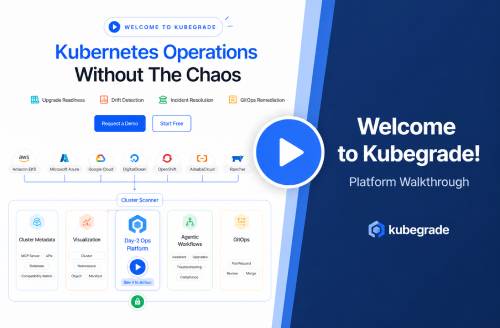
Comprehensive solution for Kubernetes Day-2 Operations