



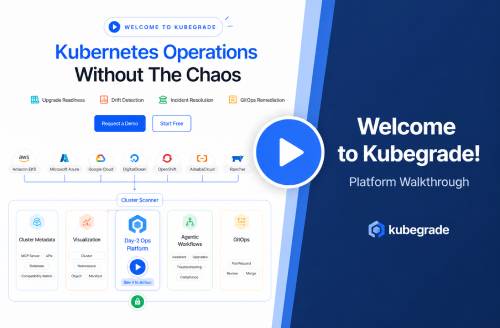


Optimizing Your Kubernetes DevOps Workflow with Kubegrade

by Tim
July 9, 2025
Kubernetes has become a key part of modern DevOps, streamlining how applications are deployed and managed. It’s an open-source platform that automates the deployment, scaling, and management of containerized applications. By using Kubernetes, development teams can focus on building and deploying applications instead of managing infrastructure.
This article explores how to optimize a Kubernetes DevOps workflow, highlighting the benefits and how tools like Kubegrade can further streamline K8s operations for secure, adaptable, and automated deployments.
Key Takeaways
- Kubernetes and DevOps together streamline application development and deployment through automation and collaboration.
- Key components of a Kubernetes DevOps workflow include CI/CD, Infrastructure as Code (IaC), automated testing, and monitoring.
- Implementing a Kubernetes DevOps workflow leads to faster deployment cycles, improved scalability and reliability, reduced costs, and enhanced security.
- Kubegrade simplifies Kubernetes cluster management, automates deployments, and improves monitoring, optimizing the DevOps workflow.
- Infrastructure as Code (IaC) enables managing and provisioning infrastructure through code, ensuring consistency and repeatability.
- Continuous Integration (CI) automates the build and testing phases, catching integration issues early.
- Continuous Delivery (CD) automates the release process, ensuring frequent and reliable deployments.
Table of Contents
Introduction to Kubernetes DevOps Workflow
Kubernetes (K8s) is an open-source platform designed to automate the deployment, scaling, and management of containerized applications. DevOps is a set of practices that combines software development and IT operations. Each brings significant advantages: Kubernetes offers automation and efficient resource utilization, while DevOps promotes collaboration, continuous integration, and continuous delivery.
The Kubernetes DevOps workflow integrates these two, creating a streamlined process for modern application development and deployment. This workflow uses Kubernetes’ ability to manage containerized applications in distributed environments, aligning with DevOps principles to enable high-velocity software delivery. It’s important because it automates infrastructure management, improves resource efficiency, and encourages collaboration between development, operations, and security teams. By abstracting infrastructure difficulties, it allows teams to respond quickly to market changes and focus on building great applications.
This article explores the benefits of the Kubernetes DevOps workflow and demonstrates how tools like Kubegrade can optimize it. Kubegrade simplifies Kubernetes cluster management through secure and automated K8s operations. It assists teams in upgrading, securing, and optimizing clusters with AI-assisted workflows, designed to keep humans in the loop and downtime out of the picture. By reducing the time spent on routine maintenance, Kubegrade allows teams to focus on strategic projects and innovation.
Key Components of a Kubernetes DevOps Workflow
A Kubernetes DevOps workflow is composed of several key components that, when working together, create a streamlined and automated deployment process. These components include continuous integration (CI), continuous delivery (CD), infrastructure as code (IaC), automated testing, and monitoring.
- Continuous Integration (CI): CI is a practice where developers regularly merge their code changes into a central repository, after which automated builds and tests are run. For example, a development team might use Jenkins, GitLab CI, or CircleCI to automatically build and test Docker images whenever code is pushed to a Git repository. This makes sure that code integrates smoothly and that issues are identified early in the development cycle. In a Kubernetes DevOps workflow, CI pipelines often produce Docker images that are then stored in a container registry.
- Continuous Delivery (CD): CD automates the release of code changes to production or staging environments. Following a successful CI process, CD pipelines take the built Docker images and deploy them to a Kubernetes cluster. Tools like Argo CD or Spinnaker can be used to manage these deployments, making sure that applications are updated with minimal downtime. For instance, when a new version of an application passes all CI tests, the CD pipeline automatically updates the Kubernetes deployment with the new Docker image. This part of the Kubernetes DevOps workflow makes sure that new features and bug fixes are delivered to users rapidly and reliably.
- Infrastructure as Code (IaC): IaC involves managing and provisioning infrastructure through code, rather than manual processes. Tools like Terraform or Kubernetes manifests (YAML files) are used to define the desired state of infrastructure, including Kubernetes deployments, services, and networking. For example, a Terraform script might define the creation of a Kubernetes cluster on AWS, Azure, or Google Cloud, along with all the necessary resources. By treating infrastructure as code, changes can be tracked, versioned, and automated, reducing the risk of errors and inconsistencies in the Kubernetes DevOps workflow.
- Automated Testing: Automated testing is a critical part of a Kubernetes DevOps workflow, making sure that applications are thoroughly tested before being deployed to production. This includes unit tests, integration tests, and end-to-end tests. For example, unit tests might verify the functionality of individual components, while integration tests make sure that different services work together correctly. End-to-end tests simulate user interactions to validate the entire application flow. These tests can be integrated into the CI/CD pipeline to automatically verify the quality of code changes.
- Monitoring: Monitoring involves continuously tracking the performance and health of applications and infrastructure. Tools like Prometheus and Grafana are commonly used to collect and visualize metrics, logs, and events from Kubernetes clusters. For example, Prometheus can collect CPU usage, memory consumption, and request latency, while Grafana provides dashboards to visualize this data. Monitoring helps teams identify and resolve issues quickly, making sure that applications are running smoothly and efficiently. In a Kubernetes DevOps workflow, monitoring provides insights into the behavior of applications in production, allowing teams to improve performance and improve the user experience.
Automation and collaboration are at the heart of the Kubernetes DevOps workflow. Automation reduces manual effort and the risk of errors, while collaboration makes sure that development, operations, and security teams are aligned and working towards common goals. By implementing these components and embracing automation and collaboration, organizations can achieve faster release cycles, improved application quality, and increased efficiency.
Continuous Integration (CI) in Kubernetes
Continuous Integration (CI) plays a crucial role in a Kubernetes DevOps workflow by automating the build and testing phases of application development. CI is a development practice where developers regularly merge their code changes into a central repository. After each merge, automated builds and tests are run.
The importance of CI lies in its ability to catch integration issues early in the development cycle, making sure code quality and reducing the risk of deploying faulty code to production. By automating the build and testing processes, CI provides faster feedback to developers, allowing them to quickly identify and fix issues.
CI pipelines work with Kubernetes by building and testing Docker images that are then deployed to a Kubernetes cluster. For example, a development team might use tools like Jenkins, GitLab CI, or CircleCI to automate the process of building Docker images whenever code is pushed to a Git repository. These CI tools can be configured to run unit tests, integration tests, and other types of tests to verify the quality of the code.
In a Kubernetes DevOps workflow, the CI pipeline typically performs the following steps:
- Detects code changes in the central repository.
- Builds a Docker image containing the application code.
- Runs automated tests to verify the functionality and quality of the code.
- If the tests pass, the Docker image is pushed to a container registry.
- Notifies the development team of the build and test results.
By automating these steps, CI makes sure that code changes are continuously validated and integrated, reducing the risk of integration issues and improving the overall quality of the application. This contributes to a more streamlined and efficient Kubernetes DevOps workflow, as highlighted in the main section on key components.
Continuous Delivery (CD) to Kubernetes
Continuous Delivery (CD) is a critical component of a Kubernetes DevOps workflow, focusing on automating the release process to make sure frequent and reliable deployments to Kubernetes clusters. CD builds upon the foundation laid by Continuous Integration (CI) by taking the validated code and automatically deploying it to various environments, including staging and production.
CD automates the steps required to release new versions of an application, reducing manual effort and minimizing the risk of human error. This automation includes tasks such as deploying the application to a Kubernetes cluster, configuring networking, and running post-deployment tests. By automating these tasks, CD enables teams to deliver new features and bug fixes to users more quickly and reliably.
Several deployment strategies can be used within a Kubernetes environment to minimize deployment risks. Some common strategies include:
- Blue-Green Deployments: This strategy involves running two identical environments, one blue (the current production environment) and one green (the new version). Traffic is switched from blue to green once the new version has been tested and validated, allowing for a seamless transition with minimal downtime.
- Canary Releases: This strategy involves gradually rolling out the new version to a small subset of users before deploying it to the entire user base. This allows teams to monitor the performance and stability of the new version in a real-world environment and identify any issues before they impact all users.
Tools like Argo CD and Spinnaker are commonly used to implement CD in a Kubernetes environment. Argo CD is a GitOps-based CD tool that automatically deploys applications to Kubernetes based on the desired state defined in Git repositories. Spinnaker is a more comprehensive CD platform that supports a wide range of deployment strategies and environments.
In a Kubernetes DevOps workflow, CD plays a vital role in automating the release process, reducing manual effort, and minimizing deployment risks. By automating the deployment process, CD enables teams to deliver new features and bug fixes to users more quickly and reliably, contributing to a more streamlined and efficient development lifecycle. This is in accordance with the key components of a successful Kubernetes DevOps workflow, as it improves automation and collaboration between development and operations teams.
Infrastructure as Code (IaC) for Kubernetes
Infrastructure as Code (IaC) is a key practice in modern Kubernetes DevOps workflows, revolutionizing how infrastructure is managed and provisioned. Instead of manual configuration, IaC allows infrastructure to be defined and managed through code. This approach brings automation, version control, and repeatability to infrastructure management, mirroring the practices used in application development.
With IaC, the desired state of the infrastructure, including Kubernetes clusters, networking configurations, and security policies, is defined in code files. These files can be version-controlled, tested, and automated, providing a consistent and reliable way to manage infrastructure. Any changes to the infrastructure are made by modifying the code and applying the changes, rather than through manual intervention.
Tools like Terraform and Ansible are commonly used for IaC in the context of Kubernetes. Terraform allows users to define infrastructure as code and provision resources across various cloud providers, including AWS, Azure, and Google Cloud. Ansible, is an automation tool that can be used to configure and manage Kubernetes clusters, deploy applications, and automate various tasks.
The benefits of IaC in a Kubernetes DevOps workflow include:
- Consistency: IaC makes sure that infrastructure is provisioned and configured in a consistent manner, reducing the risk of errors and inconsistencies.
- Repeatability: IaC allows infrastructure to be easily replicated, making it easy to create new environments for testing, staging, or production.
- Automation: IaC automates the provisioning and management of infrastructure, reducing manual effort and improving efficiency.
- Version Control: IaC enables infrastructure to be version-controlled, allowing changes to be tracked and reverted if necessary.
- Scalability: IaC makes it easier to scale infrastructure up or down as needed, responding to changing demands.
By embracing IaC, organizations can achieve greater agility, efficiency, and reliability in their Kubernetes DevOps workflow. It allows teams to treat infrastructure as a first-class citizen, managed with the same rigor and automation as application code. This contributes to a more streamlined and efficient development lifecycle, as it reduces manual effort and makes it easier to manage complex Kubernetes environments.
Benefits of Implementing a Kubernetes DevOps Workflow

Implementing a Kubernetes DevOps workflow brings many advantages to software development and deployment. Organizations that adopt this approach often experience faster deployment cycles, improved scalability, increased reliability, reduced costs, and improved security.
- Faster Deployment Cycles: A Kubernetes DevOps workflow automates many of the manual tasks involved in software deployment, such as building, testing, and deploying applications. This automation reduces the time it takes to release new features and bug fixes, allowing organizations to respond more quickly to market demands. For example, companies using Kubernetes and DevOps practices have reported reducing deployment times from weeks to days or even hours.
- Improved Scalability: Kubernetes is designed to scale applications quickly and easily. A Kubernetes DevOps workflow makes it easier to scale applications up or down based on demand, making sure that they can handle peak loads without performance degradation. This scalability is particularly important for organizations that experience seasonal traffic spikes or rapid growth.
- Increased Reliability: Kubernetes provides several features that improve the reliability of applications, such as self-healing, rolling updates, and automated rollbacks. A Kubernetes DevOps workflow makes it easier to take advantage of these features, making sure that applications are always available and resilient to failures. For instance, Kubernetes can automatically restart failed containers, reschedule them on healthy nodes, and roll back deployments to previous versions if issues are detected.
- Reduced Costs: By automating many of the manual tasks involved in software deployment and management, a Kubernetes DevOps workflow can help organizations reduce costs. Kubernetes also improves resource utilization by packing containers more efficiently onto hardware, reducing the need for additional infrastructure. Organizations have reported significant cost savings by migrating to Kubernetes and adopting DevOps practices.
- Improved Security: Kubernetes provides several security features that can help organizations protect their applications and data. A Kubernetes DevOps workflow makes it easier to implement these security features, such as network policies, role-based access control, and security audits. By automating security tasks and integrating security into the development process, organizations can reduce the risk of security breaches and compliance violations.
Compared to traditional deployment methods, a Kubernetes DevOps workflow offers significant improvements. Traditional methods often involve manual configuration, long deployment cycles, and limited scalability. A Kubernetes DevOps workflow automates these processes, enabling faster deployments, improved scalability, and increased reliability. This leads to a more efficient and agile development process, allowing organizations to deliver better software faster.
To conclude, a Kubernetes DevOps workflow provides a comprehensive approach to modern application development and deployment, offering numerous benefits over traditional methods. By embracing automation, collaboration, and continuous improvement, organizations can achieve greater agility, efficiency, and reliability in their software development efforts.
Faster Deployment Cycles
One of the most significant advantages of adopting a Kubernetes DevOps workflow is the acceleration of deployment cycles. Traditional deployment methods often involve manual processes, leading to longer release times and slower time-to-market. A Kubernetes DevOps workflow automates many of these tasks, enabling faster and more frequent releases.
The speed improvements can be substantial. Organizations transitioning to a Kubernetes DevOps workflow have reported reducing deployment times from weeks to days, or even hours. This acceleration is primarily due to automation and the implementation of Continuous Integration/Continuous Delivery (CI/CD) pipelines.
Automation plays a vital role in speeding up deployment cycles. By automating tasks such as building, testing, and deploying applications, teams can reduce the manual effort and potential for errors. CI/CD pipelines further streamline the process by automatically building, testing, and deploying code changes whenever they are committed to a repository.
For example, consider a company that previously relied on manual deployments, with each release taking several weeks to coordinate and execute. After implementing a Kubernetes DevOps workflow with automated CI/CD pipelines, the company was able to reduce deployment times to just a few hours. This allowed them to release new features and bug fixes much more quickly, responding to market demands more effectively.
Data points illustrate the impact of a Kubernetes DevOps workflow on time-to-market. A study by a leading technology research firm found that organizations using Kubernetes and DevOps practices experienced a 20% reduction in time-to-market compared to those using traditional methods. This means that they were able to bring new products and services to market faster, gaining a competitive advantage.
This faster deployment speed directly relates to the main section’s topic of benefits, as it allows organizations to deliver value to customers more quickly, respond to changing market conditions, and innovate more rapidly. The ability to deploy faster is a key driver of business success in today’s fast-paced environment, and a Kubernetes DevOps workflow provides the tools and practices needed to achieve this.
Improved Scalability and Reliability
Another key benefit of adopting a Kubernetes DevOps workflow is the improvement in application scalability and reliability. Kubernetes’ orchestration capabilities enable scaling based on demand, making sure that applications can handle varying workloads without performance degradation. The self-healing features of Kubernetes contribute to increased application uptime and a more resilient infrastructure.
Kubernetes allows applications to scale horizontally by automatically adding or removing instances based on resource utilization or custom metrics. This scaling makes sure that applications can handle peak loads without requiring manual intervention. For example, if an application experiences a sudden surge in traffic, Kubernetes can automatically add more instances to handle the increased load, maintaining performance and availability.
The self-healing features of Kubernetes further improve application reliability. Kubernetes continuously monitors the health of applications and automatically restarts failed containers, reschedules them on healthy nodes, and rolls back deployments to previous versions if issues are detected. These self-healing capabilities minimize downtime and make sure that applications are always available to users.
For example, consider a scenario where a container running an application crashes due to a software bug. In a traditional environment, this would likely result in downtime and require manual intervention to restart the application. However, in a Kubernetes environment, the self-healing features would automatically detect the failure and restart the container, minimizing the impact on users.
These scalability and reliability improvements directly relate to the main section’s topic of benefits. By providing scaling and self-healing capabilities, a Kubernetes DevOps workflow enables organizations to build more resilient applications, improving the user experience and reducing the risk of downtime. This contributes to increased customer satisfaction and improved business outcomes.
In essence, the combination of Kubernetes’ orchestration capabilities and self-healing features, when integrated into a Kubernetes DevOps workflow, provides a foundation for building and running highly available applications.
Reduced Costs and Improved Security
Adopting a Kubernetes DevOps workflow accelerates deployment cycles and improves scalability and reliability, but also leads to significant cost reductions and improved security. Resource optimization and automation play a key role in lowering operational expenses, while Kubernetes’ built-in security features, such as role-based access control (RBAC) and network policies, improve the overall security posture.
Resource optimization is a primary driver of cost savings in a Kubernetes DevOps workflow. Kubernetes efficiently packs containers onto hardware, maximizing resource utilization and reducing the need for additional infrastructure. Automation further reduces operational expenses by minimizing manual effort and the potential for human error. For example, automated scaling and self-healing capabilities make sure that resources are only provisioned when needed, avoiding unnecessary costs.
Kubernetes provides several security features that contribute to a more secure environment. Role-based access control (RBAC) allows administrators to define granular permissions for users and applications, limiting access to sensitive resources. Network policies enable administrators to control network traffic between pods, preventing unauthorized communication and reducing the attack surface.
For example, consider a scenario where an application requires access to a database. With RBAC, administrators can grant the application only the necessary permissions to access the database, preventing it from accessing other sensitive resources. Network policies can then be used to restrict network traffic to the database only from the application, preventing unauthorized access from other pods in the cluster.
These cost reductions and security improvements directly relate to the main section’s topic of benefits. By optimizing resource utilization, automating operational tasks, and providing built-in security features, a Kubernetes DevOps workflow enables organizations to reduce costs and improve their security posture. This contributes to a more efficient, secure, and cost-effective environment for building and running applications.
To conclude, the combination of resource optimization, automation, and security features makes a Kubernetes DevOps workflow a compelling choice for organizations looking to reduce costs and improve security while maintaining high levels of performance and reliability.
Optimizing Your Workflow with Kubegrade
Kubegrade offers a way to streamline and optimize the Kubernetes DevOps workflow, addressing many of the challenges associated with K8s operations. It simplifies cluster management, automates deployments, and improves monitoring, allowing teams to focus on innovation rather than routine tasks.
Kubegrade simplifies cluster management by providing a centralized platform for managing all aspects of a Kubernetes cluster. This includes features such as:
- Secure Deployments: Kubegrade automates security best practices, helping teams to securely deploy applications to Kubernetes.
- Infrastructure: Kubegrade makes it easy to scale Kubernetes infrastructure up or down based on demand, making sure that applications can handle varying workloads without performance degradation.
- Automated Upgrades: Kubegrade automates the process of upgrading Kubernetes clusters, reducing the risk of errors and minimizing downtime.
- AI-assisted Workflows: Kubegrade uses AI to assist teams in upgrading, securing, and optimizing clusters, while keeping humans in the loop.
These features directly address the benefits discussed in the previous section. Secure deployments reduce the risk of security breaches, infrastructure makes sure that applications can handle peak loads, and automated upgrades minimize downtime. By automating these tasks, Kubegrade helps organizations to reduce costs, improve reliability, and accelerate deployment cycles.
By simplifying cluster management, automating deployments, and improving monitoring, Kubegrade enables organizations to fully realize the benefits of a Kubernetes DevOps workflow. It allows teams to focus on building and delivering value to customers, rather than spending time on routine tasks. This translates into faster time-to-market, improved application performance, and increased customer satisfaction.
In essence, Kubegrade improves the Kubernetes DevOps workflow by providing a comprehensive platform for managing and optimizing K8s operations. Its focus on automation, security, and scalability helps organizations to achieve greater agility, efficiency, and reliability in their software development efforts.
Simplified Cluster Management with Kubegrade
Kubegrade simplifies Kubernetes cluster management by providing a centralized and intuitive platform for managing all aspects of a K8s cluster. It streamlines tasks such as node management, resource allocation, and cluster configuration, reducing the complexity typically associated with managing Kubernetes.
With Kubegrade, node management becomes more straightforward through features that automate tasks like node provisioning, scaling, and maintenance. The platform’s interface allows users to easily monitor node health, identify potential issues, and take corrective actions. For example, Kubegrade can automatically detect unhealthy nodes and reschedule workloads to healthy nodes, minimizing downtime and making sure application availability.
Resource allocation is also simplified with Kubegrade’s automated resource management capabilities. The platform can automatically allocate resources to applications based on their needs, optimizing resource utilization and reducing costs. Kubegrade also provides tools for monitoring resource usage and identifying potential bottlenecks, allowing administrators to address resource constraints.
Cluster configuration is streamlined with Kubegrade’s declarative configuration management features. Users can define the desired state of their cluster in code, and Kubegrade automatically applies the necessary configurations. This approach makes sure consistency across environments and reduces the risk of configuration errors.
By simplifying these tasks, Kubegrade reduces the complexity of managing K8s clusters, allowing teams to focus on building and deploying applications rather than spending time on routine administrative tasks. This simplification directly contributes to an improved Kubernetes DevOps workflow, as it enables faster deployment cycles, increased reliability, and reduced costs.
To conclude, Kubegrade’s simplified cluster management capabilities allow organizations to more effectively manage their Kubernetes infrastructure, freeing up valuable time and resources to focus on innovation and business growth.
Automated Deployments and Upgrades
Kubegrade automates deployments and upgrades in a Kubernetes environment, streamlining the release process and reducing the risk of errors. It offers automated deployment pipelines and upgrade processes designed to make sure smooth and reliable application releases.
Kubegrade’s automated deployment pipelines enable teams to define and automate the steps required to deploy new versions of their applications to Kubernetes. These pipelines can be triggered automatically whenever code changes are committed to a repository, making sure that deployments are always up-to-date. The pipelines also include automated testing and validation steps, reducing the risk of deploying faulty code to production.
One of the key features of Kubegrade’s automated deployments is zero-downtime deployments. Kubegrade uses rolling updates and other techniques to deploy new versions of applications without interrupting service. This makes sure that users always have access to the latest features and bug fixes without experiencing any downtime.
Kubegrade also offers automated rollback mechanisms that can automatically revert deployments to previous versions if issues are detected. This provides a safety net in case of unforeseen problems, minimizing the impact on users. For example, if a new version of an application causes errors or performance degradation, Kubegrade can automatically roll back the deployment to the previous version, restoring service to its previous state.
These features make sure smooth and reliable application releases by automating the deployment and upgrade processes and providing safeguards against potential issues. This automation directly contributes to an improved Kubernetes DevOps workflow, as it enables faster deployment cycles, increased reliability, and reduced costs.
In short, Kubegrade’s automated deployments and upgrades simplify the release process, reduce the risk of errors, and make sure smooth and reliable application releases, contributing to a more efficient and agile Kubernetes DevOps workflow.
Improved Monitoring and Observability
Kubegrade improves monitoring and observability in a Kubernetes DevOps workflow by offering features that provide real-time insights into cluster performance, application health, and resource utilization. These monitoring tools help identify and resolve issues quickly, improving overall system reliability and performance.
Kubegrade provides comprehensive dashboards that display key metrics related to cluster performance, such as CPU usage, memory consumption, and network traffic. These dashboards allow administrators to quickly identify potential bottlenecks and performance issues. For example, if CPU usage on a particular node is consistently high, administrators can investigate the issue and take corrective actions, such as scaling up the number of pods running on that node.
Kubegrade also provides detailed information about application health, including metrics such as request latency, error rates, and response times. These metrics allow developers to quickly identify and resolve issues affecting application performance. For example, if an application is experiencing high request latency, developers can investigate the code and identify potential bottlenecks or performance issues.
In addition to cluster and application metrics, Kubegrade also provides detailed information about resource utilization, including CPU, memory, and storage usage. This information allows administrators to optimize resource allocation and reduce costs. For example, if a particular application is consistently underutilizing its allocated resources, administrators can reduce the resource allocation for that application, freeing up resources for other applications.
By providing real-time insights into cluster performance, application health, and resource utilization, Kubegrade’s monitoring tools help identify and resolve issues quickly, improving overall system reliability and performance. This directly relates to the main section’s topic of optimizing the workflow with Kubegrade, as it enables faster problem resolution, improved resource utilization, and increased application availability.
As a result, Kubegrade’s features for improved monitoring and observability contribute to an improved Kubernetes DevOps workflow, by enabling teams to manage their infrastructure, optimize resource utilization, and make sure high levels of application performance and reliability.
Conclusion: Embracing Kubernetes DevOps for Future Success

A Kubernetes DevOps workflow offers many benefits, including faster deployment cycles, improved scalability and reliability, reduced costs, and improved security. These advantages make it important for modern application development, enabling organizations to deliver better software faster and more efficiently.
Kubegrade optimizes this Kubernetes DevOps workflow by simplifying cluster management, automating deployments and upgrades, and improving monitoring and observability. Its focus on secure and automated K8s operations helps organizations overcome the difficulties of Kubernetes and fully realize its potential.
Readers are encouraged to explore Kubegrade further to discover how it can improve their Kubernetes deployments and contribute to their overall success. By embracing a Kubernetes DevOps workflow and utilizing tools like Kubegrade, organizations can position themselves for success in application development.
Looking ahead, the future of Kubernetes and DevOps is bright. As these technologies continue to mature and evolve, they will play an increasingly important role in helping organizations build and deploy innovative applications that drive business value. The collaboration between Kubernetes and DevOps will be instrumental in shaping the future of software development, and organizations that embrace this collaboration will be well-positioned to thrive in the years to come.

