
Maintaining robust security in Kubernetes environments requires vigilant attention to updates and patches. With the rapid evolution of container orchestration platforms, staying current with security enhancements protects your applications from emerging threats.
A structured approach to managing these updates prevents vulnerabilities while ensuring operational stability across your clusters. All about Kubernetes security updates just below.

Understanding Kubernetes release cycles and security updates
Kubernetes follows a predictable release cadence with new minor versions launching approximately every three months. This schedule allows organizations to plan their upgrade strategy with confidence.
Most managed Kubernetes services, including popular cloud platforms, implement an N-2 support policy, meaning they fully support the current release plus the two previous minor versions.
Monitoring security announcements
The Kubernetes project maintains robust vulnerability reporting channels for identifying and addressing security concerns. The kubernetes-security-announce group delivers critical emails about security vulnerabilities and major API changes.
For real-time awareness, the project publishes a programmatically accessible CVE feed in both JSON and RSS formats that refreshes automatically when new vulnerabilities are discovered.
Security researchers can report potential vulnerabilities through the Kubernetes bug bounty program or by contacting security@kubernetes.io directly. This collaborative approach ensures rapid identification and patching of potential cluster vulnerabilities.
| Security Update Type | Frequency | Purpose |
| Minor Version Release | Every 3 months | New features, enhancements, and cumulative security updates |
| Patch Release | As needed | Critical security fixes and bug remediation |
| Node Image Update | Weekly (Linux), Monthly (Windows) | OS-level security patches and performance improvements |
Types of security updates
Security enhancements arrive through various update channels. An important development in 2023 was the transition from the k8s.gcr.io container registry to registry.k8s.io. Organizations must now pull their container images from this new registry as the old one no longer receives updates, which could leave outdated runtime environments vulnerable to exploitation.
Best practices for cluster upgrades
A methodical approach to Kubernetes upgrades maximizes security while minimizing service disruption. The recommended upgrade sequence begins with the control plane, followed by system node pools, and finally user node pools containing application workloads.
Pre-upgrade checklist
Before initiating any upgrade, thoroughly review these critical elements:
- Scan for deprecated APIs using specialized workbooks or tools like Fairwinds Pluto
- Review release notes for breaking changes and new security features
- Validate upgrade compatibility in lower environments before production deployment
- Verify sufficient compute resources and IP address space availability
Organizations should leverage automation tools like Terraform to streamline the upgrade process, reducing the potential for human error while ensuring consistent application of security policies across environments.
Minimizing disruption during upgrades
Carefully tune surge upgrade values to balance speed with stability. For disruption-sensitive workloads, limiting surge upgrades to 33% prevents overwhelming cluster resources. For zonal clusters, setting surge values as multiples of three ensures balanced node distribution across availability zones, maintaining application resilience during security patch deployment.
Implementing critical security mechanisms
Robust Kubernetes security requires layered protection mechanisms that work together to safeguard your containerized applications and infrastructure.
API server security
The API server functions as the front door to your Kubernetes control plane, making its protection paramount. Implement strong authentication methods like OpenID Connect rather than relying solely on built-in mechanisms. Role-Based Access Control (RBAC) provides essential authorization guardrails, limiting user permissions to the minimum necessary for their roles.
Recent Kubernetes versions have strengthened API security with improvements to the Auth API for Self-User attributes, now in Beta status. These enhancements provide more granular control over authentication processes while simplifying policy management.
Pod and network security controls
Pod Security Standards offer three progressive security postures: Privileged, Baseline, and Restricted. For most production workloads, the Restricted profile provides the strongest security posture by preventing privileged container execution and enforcing comprehensive pod security context configurations.
- Set runAsNonRoot: true to prevent container processes from running as root
- Configure minimal required capabilities and drop unnecessary ones
- Implement readOnlyRootFilesystem: true to prevent filesystem modifications
Network policies act as Kubernetes-native firewalls, controlling traffic flow between pods, namespaces, and external endpoints. These policies should be regularly reviewed and updated alongside security patches to protect against evolving network-based threats.
Node image updates and management
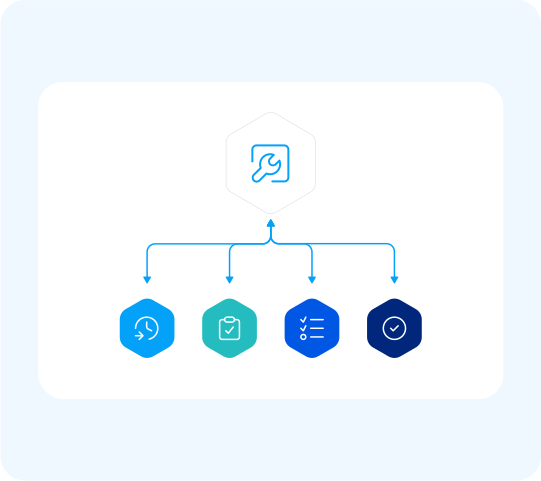
Node image updates deliver critical OS-level security patches without changing the Kubernetes version itself. These updates follow a carefully orchestrated cordon and drain process that minimizes workload disruption.
| Node Update Step | Purpose | Impact |
| Add new node with updated image | Introduce patched environment | Minimal – adds capacity |
| Cordon existing nodes | Prevent new pod scheduling | Low – existing pods continue running |
| Drain nodes sequentially | Gracefully evict workloads | Moderate – pods reschedule to other nodes |
| Remove outdated nodes | Complete replacement with secure nodes | Low – workloads already migrated |
Automating node updates
Configuring maintenance windows allows predictable scheduling of node image updates during periods of lower application usage. This approach ensures critical security patches deploy promptly without affecting peak workload performance.
Minimizing workload impact
For stateful applications with persistent volumes, properly configured Pod Disruption Budgets ensure data integrity during node updates. Combined with appropriate probe settings for liveness and readiness, these configurations maintain application availability throughout the security patching process.
Security best practices across build, deploy, and runtime phases
Comprehensive Kubernetes security extends across the entire application lifecycle, with specific measures required at each phase.
Build phase security
During the build phase, ensure container images contain only necessary components and come from trusted sources. Implement rigorous image scanning in your CI pipeline to identify vulnerabilities before deployment. When possible, utilize distroless or minimal base images to reduce the potential attack surface within container environments.
Deploy phase security
At deployment time, implement namespace isolation to contain potential security breaches. Apply ResourceQuotas to prevent resource exhaustion attacks, and implement admission controllers like ImagePolicyWebhook to enforce image provenance rules.
Runtime phase security
- Deploy runtime security tools that monitor container behavior for anomalies
- Rotate infrastructure credentials frequently to limit exposure from compromised secrets
- Enable comprehensive audit logging for security-relevant API activities
Consider container sandboxing technologies like gVisor or Kata Containers for workloads processing sensitive data, providing additional isolation between application containers and the host kernel.
Stay protected with automated Kubernetes security updates : get your personalized quote from Kubegrade today.